
What a Speed Test Is Really For: A Guide to Usage and Impartiality
How a real speedtest works and why ISP results differ from independent tests. A practical guide to reading and using your speed test results correctly.
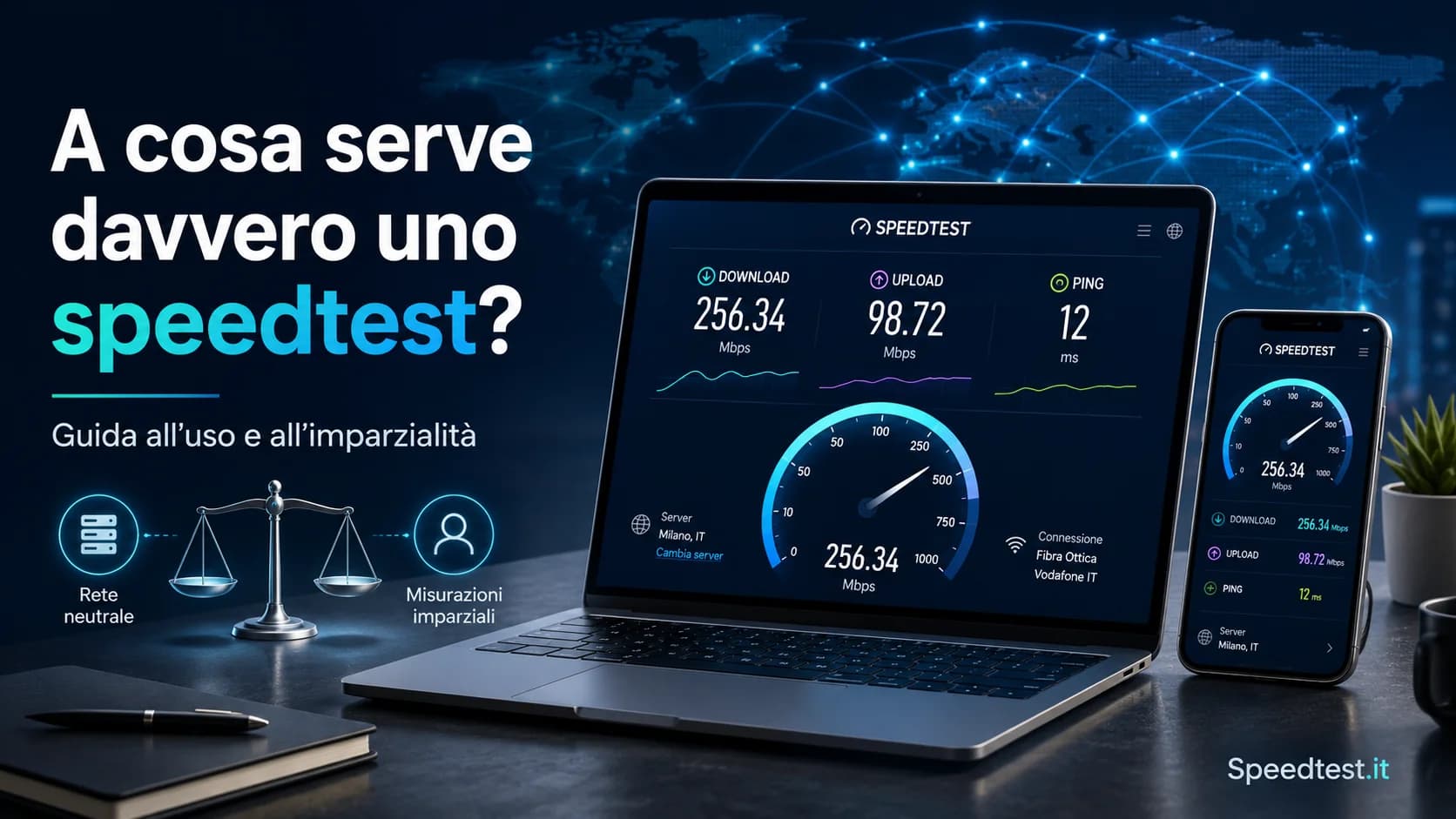
We live in a constantly connected world, where the loading spinner during a movie stream or lag during an online game can ruin an evening. The first reaction is almost always the same: open the browser and run a speedtest.
But what do those numbers really tell us? And above all, why aren't all speedtests created equal? In this article we'll shed light on how to interpret the data, why server impartiality is fundamental, and... a fun little secret for those who want to "cheat".
The Speedtest: A Diagnostic Tool, Not the Absolute Truth
It's important to start with a fundamental premise: a speedtest is an indicative tool.
Think of it as a snapshot of highway traffic. It tells you how fast the cars (data) were moving at that precise moment, on that specific lane. However, it can't guarantee the situation will be identical 10 minutes later or if you take a different road.
A speedtest is extremely useful for getting a third-party, objective overview of your line's health, to understand whether there are major technical problems or whether your ISP is broadly keeping its contractual promises. However, it's not a tool to base a legal assessment on (unless you use specific certified software) or to consider 100% infallible, since the variables at play are infinite: from your modem, to the cable you use, to the load on the global network at that moment.
Why Impartiality Matters: The Speedtest.it Advantage
Here we get to the heart of the matter. If you want a real picture of your connection, you need to ask yourself: "Which server am I testing against?"
Many online measurement tools are owned by the same telecom operators or have direct peering agreements with them. This means that if you test an "Operator X" connection against an "Operator X" server, your data stays within their private, often optimized network, showing you the maximum theoretical speed possible. It's like racing on a private track instead of real city traffic.
Speedtest.it's strength is its total independence.
- No preferential agreements: We have no agreements with internet providers (ISPs) to inflate results.
- Diversified connectivity: Our tests use impartial servers and real traffic routes, the same ones your data travels when you browse international sites, watch Netflix, or download files.
- The real picture: Testing on impartial servers shows you how your connection behaves in the "real world," outside your ISP's "comfort zone."
How to Run a Reliable Test
While the tool is indicative, you can follow these steps to make it as accurate as possible:
- Use Cable: If possible, connect your PC to the modem via Ethernet cable. Wi-Fi introduces too many interferences.
- Close Everything: Stop streaming, downloads, and close unused browser tabs before starting the test.
- Repeat: Run multiple tests at different times of day to get a reliable average.
Beyond Speed: The Importance of an "Independent," Professional Provider
Sometimes, though, the problem isn't speed itself, but the intrinsic quality of the connection. If the test gives you good numbers but you struggle with advanced services, the problem might be the type of contract or ISP you've chosen.
"Mass-market" providers bet everything on big consumer numbers, often neglecting technical characteristics fundamental for businesses, developers, and pro-sumer users. Let's not forget that a speedtest is useful precisely because you don't trust the bandwidth offered by a provider that clearly offers shared-bandwidth services. But those with specific needs — such as remotely accessing their home automation system, managing high-definition video surveillance, or configuring servers and VPNs — can't settle for a standard connection.
In these cases, the solution is to turn to specialized providers, true web professionals like OlimonTel.it. Unlike consumer offerings, providers of this caliber offer dedicated bandwidth internet services and essential features such as:
- Static Public IP: Indispensable for stably and securely reaching your own network remotely, without resorting to unstable DDNS services.
- IPv6 Subnet: An increasingly requested feature from developers and necessary for the future of the Internet of Things (IoT).
- Qualified support: Talking with technicians who understand your needs, rather than generic call centers.
Choosing a Fiber Internet connection from a provider like OlimonTel means moving from simple "browsing" to structured connectivity, designed for those who work with the internet, with services like FTTO Internet.**
The "Fake Speedtest": When Appearance Matters More Than Substance**
We've talked about precision and reality, but let's admit it: sometimes vanity takes over. There's a curious tool on the web, the so-called Fake Speedtest.
What is a service that lets you generate a fake screen with a stratospheric download speed (say, 10 Gbps) and a nonexistent ping good for? Obviously not for diagnosing your network, but it's the perfect weapon for pranks.
It's useful for:
- Pranking friends: By sending them a screenshot where your old ADSL seems to have transformed into a NASA connection.
- Social Status: For those who want to brag on social media about having the fastest connection in the group (even though they're still waiting for a video to load).
- Trolling colleagues: "Strange that the video call is choppy — look at this, my line is perfect!"
Remember though: using a Fake Speedtest is fun for five minutes, but when you need real answers and want to understand why the internet is slow, come back to Speedtest.it for the plain truth.
Want to discover the real speed of your line right now? Click here to start the test on Speedtest.it
← All articles