
The AI Paradox: the Web That Feeds It Is Dying
Wired Italy shuts down, Google answers before the click, AI increasingly trains on its own output: a look at model collapse from someone who lived through the early internet.
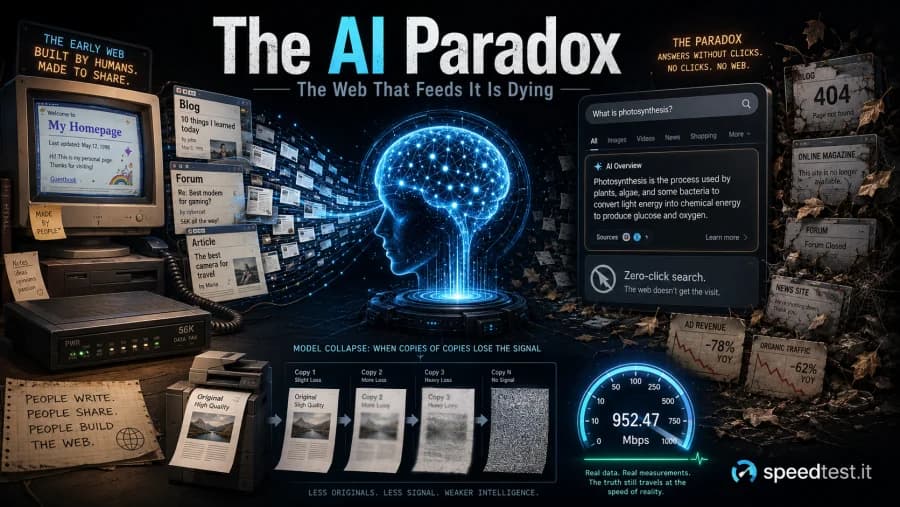
The first modem I ever heard screech topped out at a theoretical 56k and never actually reached it. Thirty years later, I ask an AI to explain how fiber optics work and it answers in under a second, without me opening a single website. That second is where a paradox nobody talks about enough is hiding.
Anyone who lived through the early internet remembers the noise. That screech, that crackle, those fifteen seconds of waiting while a page loaded line by line, top to bottom, as if the site were revealing itself one pixel row at a time. They remember GeoCities pages full of animated gifs, forums where people argued for hours about external modems and graphics cards, the first blogs written by real people sharing their lives or their expertise for no reason other than the joy of sharing it.
That web worked because of a simple exchange: you write, I read, banner ads pay for the server. An implicit deal that held for twenty years and is now breaking apart in front of us.
Wired Italy is just the symptom
In June 2026, Wired Italy shut down. It's not an isolated case, it's a symptom. Before it, dozens of magazines, local outlets, and independent blogs that had produced quality journalism for years disappeared. The cause is never just one thing, but two forces are braiding together in a particularly dangerous way.
The first is that we're no longer willing to pay almost anything for online content. We spent twenty years getting used to free — free funded by advertising, which in turn lived off traffic. But when traffic collapses, the whole structure collapses with it.
And traffic is collapsing for the second, less-discussed reason: Google, through Gemini and AI Overviews, now hands you the answer directly on the results page. You no longer need to click through to a website to learn how to install WireGuard on Debian or what technically separates 4G from 5G. The answer is right there, summarized, ready, free. It's called "zero-click search," and for most informational queries it's already today's normal.
The consequence is easy to picture: if the site that wrote that guide stops getting visits, it stops getting ad revenue. If it stops getting ad revenue, it shuts down. And when it shuts down, that guide disappears from the web forever.
The problem is that AI still needs us
Here's the part that keeps me up at night, as someone who's worked with technology since technology was still a hobby for the few.
AI models aren't born knowing things. They're trained by reading enormous quantities of text written by humans: articles, forums, technical documentation, blogs, wikis. That's where they learn what a firewall is, how to configure a DNS record, what "available bandwidth" actually means versus "advertised bandwidth." The human web is their textbook.
But if the economic model that keeps that web alive is collapsing — if Wired Italy shuts down, if independent technical blogs disappear one after another because nobody visits them anymore — who's going to write the next textbook?
The answer, today, is already unfolding: the AI writes it itself. Some estimates suggest a huge share of newly published online content — in certain categories, reportedly already above 90% — is now AI-generated or AI-assisted. And that's where the loop closes, in a way that should send a chill down any engineer's spine.
Photocopying a photocopy
Picture photocopying a page. The copy will look almost identical to the original, with a tiny, imperceptible loss of sharpness. Now photocopy that copy, and then the copy of the copy, a thousand times over. By the thousandth photocopy, the text is no longer readable: it's noise, smudges, a shadow of the original.
That's exactly what researchers call "model collapse," and it isn't science fiction — it was demonstrated scientifically in a study published in Nature in 2024 (Shumailov et al., "AI models collapse when trained on recursively generated data"). When a language model is trained — even partly — on text generated by other language models, errors don't stay stable: they amplify with every generation. Rare nuances disappear first, then correct-but-uncommon technical details, then the very diversity of language itself, until what's left is an increasingly uniform, increasingly impoverished mush that looks more and more like itself.
Today that error is small. A slightly imprecise technical detail in a guide about a network protocol, a lost nuance in an explanation of cryptography, outdated information passed off as current because nobody bothered updating it once the economic incentive to do so disappeared. Small, today. But the web we're building in 2026 will be the training material for the models of 2030, which will in turn write the material for 2034. Every generation photocopies the previous photocopy, with fewer and fewer real humans in the loop to correct, verify, and update it with direct experience.
Ten years from now, today's small error could have become a chasm. Not because of AI itself, but because we'll have stopped feeding it real food.
What's left, when everything else is gone
I don't think the answer is nostalgia for 56k modems, and I don't think AI is the enemy either — I use it every day, and you're probably using it right now to read a summary of this article instead of the full piece. The problem isn't the tool, it's the balance that's breaking.
What I do think is this: if human-made content becomes scarce, it also becomes valuable. The things an AI can't invent are exactly the things worth continuing to write: a genuinely measured data point, a genuinely lived experience, a mistake genuinely made and honestly recounted, a test actually run instead of statistically inferred.
That's part of why here at speedtest.it we keep measuring the real speed of internet connections instead of estimating it: a verifiable number, generated by a real test run by a real person on their real network, is exactly the kind of primary data no AI can generate on its own. It can summarize it, it can explain it, but it can't invent it from nothing unless someone, somewhere, actually measured it first.
Maybe that's the real lesson of thirty years online: the tools change, the protocols change, page-load time has gone from one pixel row at a time to a whole site in three hundred milliseconds. But the value has always been the same thing — someone who genuinely lived or measured something, and had the patience to write it down so someone else could learn from it. It's still worth doing, even now that the hungriest audience for that knowledge isn't just people anymore, but also the machines people built.
← All articles